

Beginner’s Guide to Lake Shore Maintenance
How to Get Rid of Lake Weeds and Muck?
Treating your lake shore is more manageable than you might expect, especially once you learn the basics of treating it. Treatments will be needed multiple times a year to keep the lake shore clear. Many people stick to lake weed treatment plans for success throughout the year.
Improving your lake shore starts with a few simple steps: identify the weeds, treat with the right herbicides and algaecides, and finally reduce all the muck that has built up. This article will guide you through each step so you can enjoy your lake shore to the fullest again.
Step 1: Identify Lake Weeds
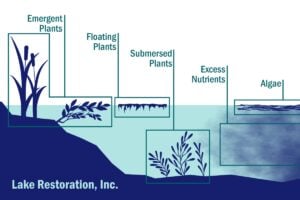
When it comes to weed identification, there are 4 categories: emergent, submerged, floating, and algae. Identifying the target species is a crucial first step to lake weed treatment because each type of weed requires a different treatment.
Emergent Weeds
Emergent weeds are rooted to the bottom and either emerge from the water’s surface (like cattails or phragmites) or have leaves that float on the water (like lilies or watershield). They are complex plants and often have vast root systems that weave under the sediment.
Submerged Weeds
Submerged weeds are plants that grow entirely or almost entirely underwater. There are many different types of submerged weeds including coontail, Hydrilla, and milfoil.
Multiple types of pondweeds have submersed leaves, different leaves that float on the water, and flower spikes that stick up a few inches out of the water. They are still considered to be in the submerged category.
Floating Weeds
The two most common types of floating weeds are duckweed and watermeal. Floating weeds are not truly rooted to the bottom.
Some weeds in the floating category have modified leaves that hold on to the bottom of a lake but are not real roots. If the floating weeds have actual roots attached to the bottom (such as water lilies or watershield), then they are in fact emergent weeds.
Algae
Planktonic algae can make the water look cloudy, green, or like paint or oil has been spilled. Filamentous algae start at the bottom, forming long strands and oftentimes bubbling when floating to the top and forming mats. Chara and starry stonewort look like submerged plants but are complex branched algae.
Lake weeds identification is important because every weed requires a different treatment plan. You will see the best results if you can identify the weeds surrounding your lake shore. If you’re having trouble identifying the weeds, feel free to email a photo to Plants@lakerestoration.com. Our sales staff would be happy to take a look!
Step 2: Treat with Herbicides and Algaecides
We offer many different herbicides and algaecides that are used for treating your lake shore. The best algaecides and herbicides for your lake can be found in our three different Lake Weed Treatment Bundles. The Lake Weed Treatment Bundle and the Granular Dock & Swim Area Products are carefully selected packages that include the necessary herbicides and algaecides to control lake weeds. Here is a list of lake herbicides and algaecides for each type of vegetation:
| Type of Vegetation | Possible Products |
| Algae | Mizzen Copper sulfate Hydrothol, if algae are not severe |
| Emergent | RestoreAccess with RestorationPRO |
| Free floating | Dibrox Hydrothol |
| Rooted floating | Depends on exact weed types RestoreAccess 2, 4-D Dibrox Hydrothol |
| Submerged | Hydrothol Dibrox |
Once you know which product(s) will treat your target species, it’s time to choose the package that best suits your needs. This chart shows the similarities and differences of our Lake Weed Treatment Bundles:
| Lake Weed Treatment Bundle | Granular Dock & Swim Area Products | |
| Form | Liquid | Granular |
| Products Included | Bayflox herbicide Dibrox herbicide Mizzen algaecide | Hydrothol herbicide (& mild algaecide) MuckMaid pellets |
| Herbicide/algaecide application | Dilute with water and spray (can mix Bayflox plus Dibrox & Mizzen together in same sprayer) | Broadcast granules |
| MuckMaid application | Toss pellets in |
Step 3: Lake Muck Removal
The best muck remover for lakes is MuckMaid. It devours the muck, eating away inches with each application! MuckMaid is an effective pond and lake muck removal solution that will make your water clear and allow you to get down to the nice hard bottom.
The beneficial bacteria in MuckMaid pellets get rid of lake muck by going through a complex process, breaking down organic matter into nitrogen gas, which floats back up into the air. Nitrogen gas makes up most of the air we breathe, so it is perfectly safe.
Once the pellet application is complete, you can swim and fish immediately. MuckMaid is paired with every Lake Weed Treatment Bundle because it is so effective.
How to Apply MuckMaid
For successful lake muck removal, evenly distribute the pellets across the treatment area whenever the air temperature is 50-90° F. MuckMaid pellets can simply be tossed into the water using a scoop.
They work best when used consistently until the muck is gone. MuckMaid eats one to three inches of muck per treatment, so multiple treatments will likely be necessary for total lake muck removal.
Apply muck remover pellets every two to four weeks from spring through fall for maximum effectiveness. Regular use ensures long term results and prevents future muck buildup.
Muck Blaster
Another great solution to clear muck from your lake shore is to use the Aqua Stormfuro. This product is an excellent choice for chemical free floating weed, algae, and muck removal.
The Aqua Stormfuro blasts water underneath the surface to keep debris and weeds from entering your property and is the only product of its kind on the market that has a cage on both the inflow and outflow ends of the motor. This is for added safety and protection to keep weeds and fish away from the propeller.
Conclusion
Breaking down the steps for treating your lake shore makes the process much easier and more manageable. Lake weed management starts with a few simple steps: identify the weeds, treat with the right herbicides and algaecides, and finally remove all the accumulated muck.
There are four main categories when identifying lake weeds: submerged, emergent, floating, and algae. Each category requires a different product. After treating the weeds, it is essential to treat for any accumulated muck. This will help with having a clear, sandy bottom in your swimming area.
Call 763-428-9777 with any questions or email LRmail@lakerestoration.com.